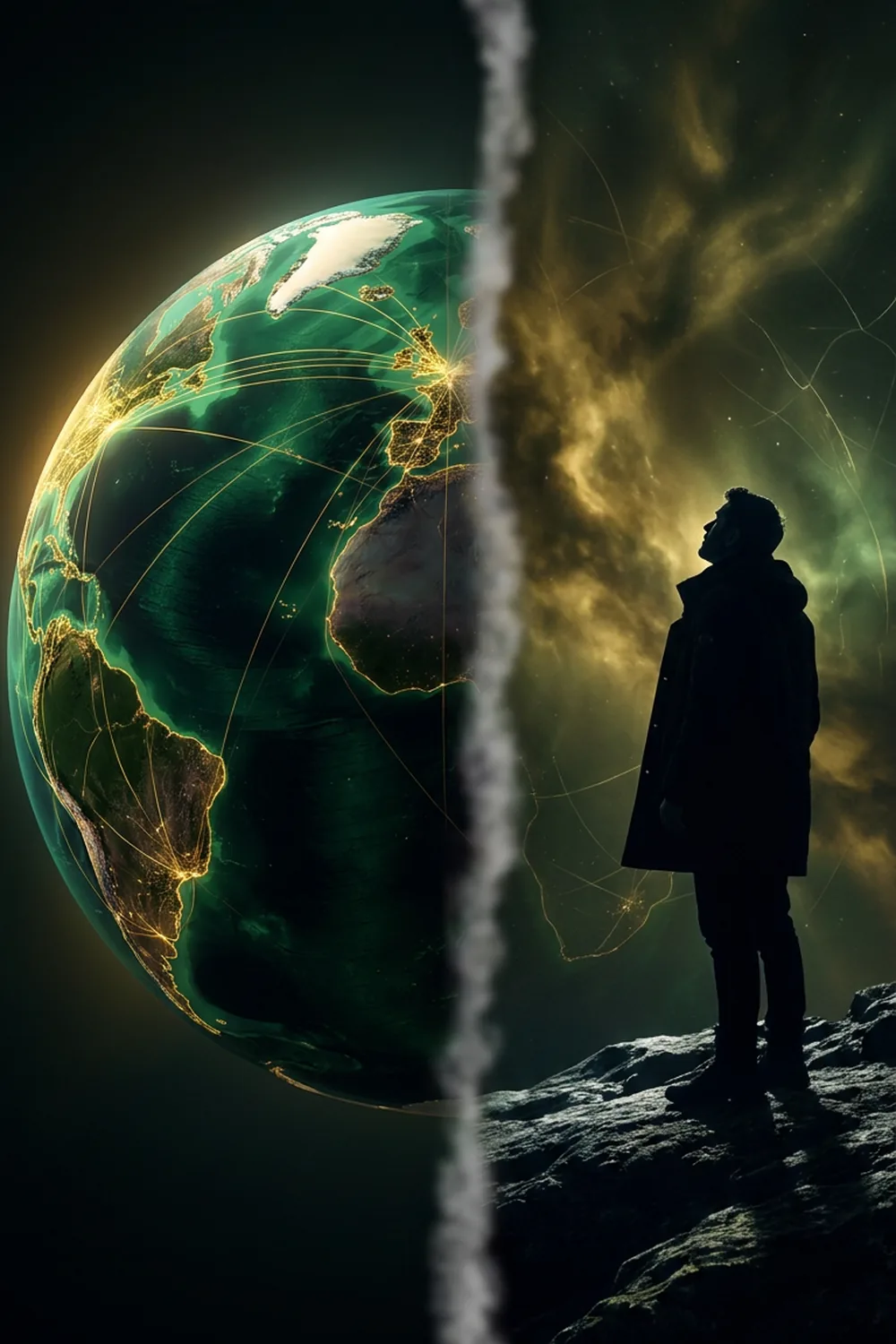
Is astrocartography real or just astrology? It is astrology — a real branch of it, drawn onto the Earth. It takes the chart you were born with and maps its planetary lines across the globe, so you can see where each theme is strongest. It does not promise events. It offers a map of meaning. Whether you call it real depends on what you mean by real.
Is Astrocartography Real or Just Astrology? The Short Answer
Astrocartography is not a rival to astrology. It is a branch of it — the branch that asks where. The chart stays the same; the map changes. BBC Travel calls it "a map of meaning," and one of its practitioners calls the charts "treasure maps of the world."
So "just astrology" is the wrong phrase. It is like saying a map is "just geography." The map does not replace the land. It helps you read it.
The land stays the land. The reading is what changes.
Astrocartography is a language of places, not a list of verdicts.
Where Did Astrocartography Come From?
The practice was popularized in the 1970s by the American astrologer Jim Lewis, who wrote The Psychology of Astro*Carto*Graphy and gave the system its name. The Old Farmer's Almanac traces the modern method to him, while noting that reading places from the sky is far older than the name.
The recent attention is new. BBC Travel reports that search interest in astrocartography spiked over the past year, and that Royal Caribbean brought a professional astrocartographer on board in 2025 to help guests choose itineraries.
Lewis did not invent the sky. He drew it on the ground.
How Does Astrocartography Actually Work?
An astrocartographer casts your birth chart for the exact moment and place you were born, then projects it onto a world map. Each planet leaves four lines, one for each cardinal point: the Ascendant (how you are met), the IC (home and roots), the Descendant (partnership), and the Midheaven (career and visibility).
The planet supplies the theme. A Sun line is vitality and self-expression. A Moon line is emotion and belonging. Venus brings beauty and affection; Mars brings courage and action; Jupiter brings expansion and connection. Saturn brings lessons, Neptune brings imagination, and Pluto brings transformation.
Most practitioners read a wide band around each line — the Almanac notes an orb of roughly 600 miles — and pay attention to where lines cross. Those crossing points, called parans, concentrate the energy of both planets in one region.
A line is not a verdict. It is a theme with an address.
How Do You Read Your Own Astrocartography Map?
Start with your birth data: date, exact time, and place. The time matters more here than in most astrology, because the four angles move quickly — a few minutes can shift a line by miles.
Generate the map on a site like astro.com or astro-seek, both recommended by the Almanac. You will see a world map covered in colored lines, each labeled with a planet and an angle: AC, IC, DC, or MC.
Then narrow the field. Pick one goal before you look — rest, love, work, adventure — and find the planet that speaks to it. Trace its line. Read the band around it, not the pixel. Look for crossings, where two lines meet and two themes combine.
Finally, test it. Choose a place on the line, go, and keep notes. The map is a hypothesis. The trip is the experiment.
Why Do People Say It Works?
Because places feel like something, and the map gives that feeling a name. In the BBC Travel piece, a traveler describes standing in Santorini on a line associated with rest; another describes arriving in Marbella, on her Sun line, and feeling her confidence return within hours. A psychotherapist quoted in the same article explains the appeal simply: when the world feels chaotic, people look for structure, and a map offers it.
That is testimony, not proof. But testimony is how most human traditions travel — one person tells another what a place did for them, and the next person goes to see.
What the map really offers is permission: to trust a pull, to book the place that has always called, to stop scrolling and choose.
People do not need proof to feel a place. They need a name for what they feel.
What Do the Four Lines Feel Like in Practice?
Take one traveler with four cities on four different lines. On a Venus-Descendant line, the city feels softer: easier conversations, kinder strangers, a sense of being liked before being known. On a Jupiter-Midheaven line, the same person feels larger — more visible, more ambitious, more willing to introduce themselves.
On a Saturn-IC line, the city feels serious. The apartment matters. The responsibilities matter. It is not a holiday line; it is a growing-up line. On a Moon-IC line, the city feels like home before the second day — the café remembers you, the street knows your pace.
Same traveler. Four cities. Four chapters. None of them promised. All of them possible.
What Astrocartography Does Not Claim
It does not promise events. The Almanac puts it plainly: astrocartography does not forecast exact outcomes; it highlights places where certain themes are more likely to be felt. Astrologer Lisa Stardust adds the line worth framing: "Don't let the stars hold you back from living your life."
The choice stays with you. The map describes the weather of a place. You still pack your own bags.
How Is TripSpot's Hermetica Different From a Line on a Map?
Somewhere, the sky already has your name on it. TripSpot finds the address.
A single line shows where one planet speaks. Hermetica listens to the whole sky. It reads your birth date, time, and place across five systems — Western Astrology, Numerology, Nine Star Ki, BaZi, and Egyptian Soul — and then reads the exact travel dates you have chosen. It returns one destination for that window, not a chart for you to interpret alone.
Then the accommodation engine goes to work: years of refinement, searching and comparing so you get the right room at the right price for your budget. And if you travel as a pair, the Twin Souls reading fuses both charts into one signature before naming a single sanctuary for two.
If you want the full explanation of the lines themselves, read what astrocartography is and how it works. If you are choosing a companion, read who you should travel with based on your zodiac sign.
So — Real or Just Astrology?
It is astrology, whole and undiluted, with a passport. It inherits everything astrology is — an ancient art of reading meaning from the sky — and adds a question the sky has always been asked: where?
You do not have to settle the metaphysics to use the map. You only have to be honest about what it is: a tradition, a language, a way of listening to a place before you go.
The honest answer has two halves. As a practice, it is as real as any language people use to talk about place — and languages shape where we go. As a claim about the universe, it belongs to the same ancient conversation as the rest of astrology: a conversation about meaning, not measurement.
It does not ask to be weighed on a scale. It asks to be read.
Call it what it is: astrology with a passport.
Frequently Asked Questions
Is astrocartography real?
It is real as a tradition and as a map of meaning — a branch of astrology with a documented method and a growing following. It does not claim to be a physical force. Whether it is "real" in that deeper sense is a question each traveler answers for themselves.
Who invented astrocartography?
The modern system was popularized and named by the American astrologer Jim Lewis in the 1970s. He wrote The Psychology of Astro*Carto*Graphy, which remains the foundational text. The idea of reading places from the sky is much older than the name.
What do the lines on an astrocartography map mean?
Each planet draws four lines: the Ascendant (how you are met), the IC (home and roots), the Descendant (partnership), and the Midheaven (career and visibility). The planet supplies the theme; the angle supplies the area of life.
Can astrocartography tell me where to live?
It can describe which themes are strongest in a place, which is useful for reflection. It does not decide for you. As astrologer Lisa Stardust puts it, do not let the stars hold you back from living your life.
How does TripSpot use astrocartography?
TripSpot's Hermetica goes beyond a single line: it reads five systems plus your exact travel dates and names one destination for your window, then finds the right stay at your budget. For two travelers, the Twin Souls reading fuses both charts first.
Your sun sign is only page one. Your full birth chart — date, time, and place — is the whole book. Bring it to the Oracle with your dates, and let the map become one place.