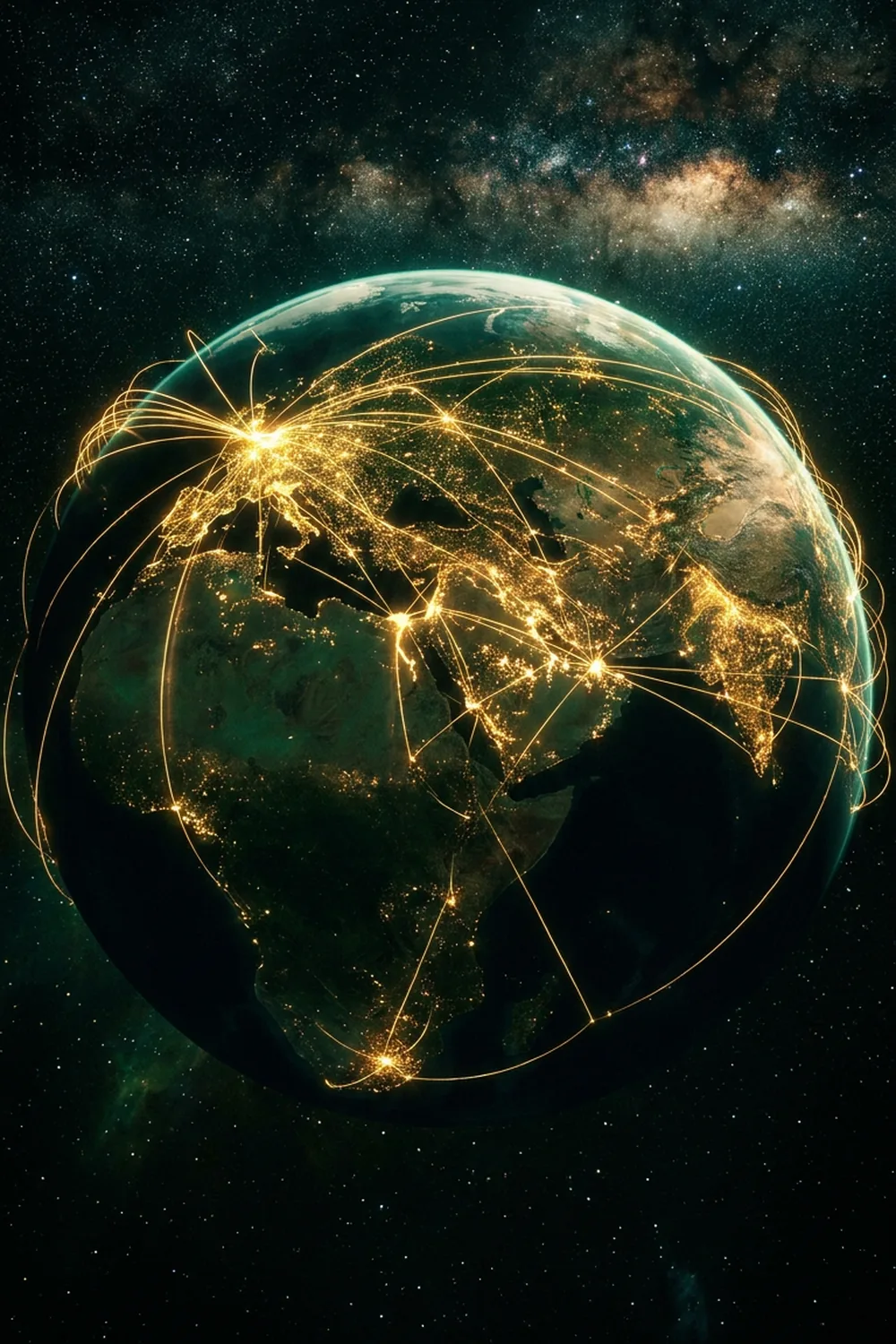
What is astrocartography and how does it work? Astrocartography is a branch of locational astrology that lays your birth chart over a world map. It shows where the Sun, Moon, and planets were rising, setting, culminating, or anti-culminating at the moment you were born — and those lines are read as places where a particular kind of energy is emphasized.
What Is Astrocartography and How Does It Work? The Short Answer
Imagine your birth chart — the circle of planets at the moment you were born — picked up and laid across a map of the Earth. That is the basic idea. For every planet in your chart, astrocartography draws four lines around the globe: where that planet was rising, setting, at its highest point, and at its lowest point. The lines are called planetary lines. The closer you are to a line, the more that planet's energy is emphasized in that place.
A Venus line may feel beautiful and relational; a Saturn line may feel demanding and structured; a Jupiter line may feel expansive. The map does not tell you what will happen. It shows where a particular theme is loudest.
Where Did Astrocartography Come From?
Astrocartography is modern, but its roots are old. People have used the sky to choose places for centuries; locational astrology — the idea that a chart can be read for a place, not only a person — is much older than the word. The modern map was pioneered in the 1970s by Jim Lewis, an American astrologer who built on that older tradition and gave it a name. He patented a system for mapping planetary lines in 1981.
National Geographic has reported that astrocartography is moving into the mainstream as travelers look for “meaning-driven experiences.” That is a long way from a niche practice. The map is a modern tool, but the question it asks is ancient: where does this person belong?
How Do You Read an Astrocartography Map?
Start with your birth data: date, time, and place. The time matters, because the lines are calculated from the exact positions of the planets at the moment you were born. Even a few minutes can shift a line.
Then look at the lines that cross the places you are curious about. Each line is named for a planet and an angle. A line labeled Venus MC, for example, is where Venus was at its highest point at your birth. A line labeled Saturn AC is where Saturn was rising. The planet describes the theme; the angle describes how that theme meets the world. You do not need to memorize every combination. Start with the planet you need most right now — beauty, growth, structure, rest — and see where its lines fall.
Finally, read the map as a layer, not a verdict. A line can describe the mood of a place, but it cannot tell you about your budget, your visa, or the friend you will meet there. It is a map of emphasis, not a map of certainty.
What Do the Four Angles Mean?
Every planetary line is one of four angles:
- AC (Ascendant): where the planet was rising. This is the line of first impressions — how a place meets you, and how you meet it.
- DC (Descendant): where the planet was setting. This is the line of relationship — the people and partnerships a place may bring.
- MC (Midheaven): where the planet was at its highest point. This is the line of visibility, work, and public life — what a place asks you to become in the world.
- IC (Imum Coeli): where the planet was at its lowest point. This is the line of home, roots, and private life — what a place makes you feel underneath.
The planet is the theme; the angle is the room in which that theme plays. A Venus MC line is not the same as a Venus IC line. One may be about being seen; the other about feeling at home.
What Does Each Planet Mean on the Map?
This is the short language of the planets, as astrologers use it:
- Sun: identity, vitality, the self you are becoming. A Sun line can feel like a place that asks you to show up.
- Moon: home, memory, emotional safety. A Moon line can feel familiar, like a place you have been missing.
- Mercury: words, learning, movement. A Mercury line can feel curious, busy, full of conversation.
- Venus: love, beauty, pleasure, harmony. A Venus line can feel softer, sweeter, more relational.
- Mars: action, courage, desire, friction. A Mars line can feel energizing — or argumentative.
- Jupiter: growth, opportunity, generosity, faith. A Jupiter line can feel expansive, like the door is open.
- Saturn: structure, discipline, time, responsibility. A Saturn line can feel demanding — and maturing.
- Uranus: independence, change, surprise. A Uranus line can feel electric, unstable, alive.
- Neptune: imagination, compassion, mystery. A Neptune line can feel dreamy — or confusing.
- Pluto: depth, power, transformation. A Pluto line can feel intense, private, and hard to ignore.
You do not need all ten. Most travelers start with one or two themes: rest, love, work, or a new beginning.
What Does It Feel Like to Travel to a Line?
Some travelers describe a line as a kind of recognition. They land and feel more like themselves; or they feel a resistance they did not expect. A Venus line may feel unusually warm; a Saturn line may feel like a test; a Jupiter line may feel like a door opening. Others feel nothing at all — and that is useful information too.
The map shows emphasis, not a script. A line is not a light switch. Give it time. Walk the same street twice. Notice what the place asks of you. The most honest reading is the one you feel in your body, not the one you expected from the map.
What Astrocartography Is Not
It does not promise luck; a Saturn line does not promise hardship. It is not a substitute for practical planning: visas, budgets, well-being, weather, and the people you travel with matter more than any line. It is not the whole chart. Astrocartography is one branch of locational astrology, and a personal reading can draw on much more — your Sun, Moon, and rising sign; your Life Path number; the balance of the elements.
And it is not a verdict about your life. It is a lens for a place question. The final choice is still yours. If you want the wider map, read where should I travel based on my zodiac sign. If you want the bigger question, read is astrocartography real or just astrology.
How Does Astrocartography Fit Into a Personal Reading?
Astrocartography is one branch of the astrology of place. A personal reading can use it as a lens, or it can draw on other systems. Hermetica reads five systems together — Western Astrology, Numerology, Nine Star Ki, BaZi, and Egyptian Soul — then reads the travel dates you have chosen against them. The result is one destination, selected for that exact window: not a list of lines, not a maybe.
The map gives you the language of place. The full reading gives you the place. And because the journey does not end at the airport, the same reading is paired with an accommodation engine we have spent years refining — one that searches, compares, and curates so you get the best match at your budget, not an endless wall of options.
The weather, how you get there, the company, and the moments in between are yours. The destination — chosen for you and for your dates — is ours.
Frequently Asked Questions
Is astrocartography the same as astrology?
No. It is a branch of locational astrology. A birth chart describes the person; astrocartography projects that chart onto a world map to read places.
Do I need my exact birth time for astrocartography?
Yes, birth time matters because the lines are calculated from the exact chart. Even a few minutes can shift a line. If you do not know your time, a solar chart can still give a general direction, but the lines are less precise.
Can I feel anything on an astrocartography line?
Some travelers report a strong sense of recognition or resistance; others feel nothing. The map shows emphasis, not a script. Give it time, and notice what the place asks of you.
What is the difference between astrocartography and a birth chart?
A birth chart describes your inner architecture. Astrocartography lays that architecture over the world map. One is the person; the other is the person in place.
Is astrocartography only about moving abroad?
No. It can inform a trip, a sabbatical, a city to visit, or a place to live. It is a lens for any place question.